


Home Feels Distant

Updated: Aug 2
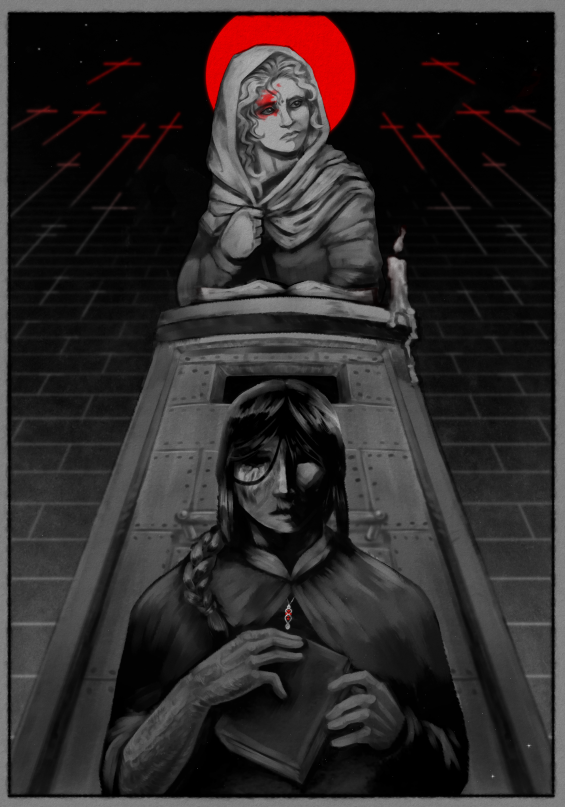
Home Feels Distant is a narrative-driven walking sim rooted in the rich culture, history, and language of Wales. With its distinct visual style and immersive storytelling, players follow the journey of a fictional sixth Welsh “witch”, Gwenhwyvar, whose fate during the European witch trials takes an unexpected turn. Unlike those before her, Gwen’s story holds secrets that begin to unravel after her failed execution.
Set within the crumbling, fictional basement of St Govan’s chapel, the game spans 400 years of Welsh history, blending key moments from four major time periods. As time distorts, players must piece together not just where they are, but when- in a haunting exploration of memory, myth, and identity.
At its core, Home Feels Distant is a story of love, loss, and hiraeth: a uniquely Welsh feeling of longing for a home that may no longer exist.
The game aims to break new ground in representing Welsh heritage, shedding light on why the witch trials largely bypassed Wales, and weaving that history into a fictional yet emotionally resonant tale.
The Story

The game is set in a small town on the west coast of Wales, away from the majority of influences that had begun to bleed into the country at the time.
Wale was largely preoccupied by theft, thanks to the poverty typical in the country, and so did not have the means or time to become invested in the witch trials Europe saw; though other reasons are thought to have prevented it too. This poverty impacted other social norms at the time, as local populations became reliant on “wise women” to cure illnesses and deal with medical problems in the wake of a complete lack of hospitals within the country.
The Welsh people, traditionally, are incredibly superstitious, with changelings, fairies and supernatural creatures being a large staple in the culture. This, along with an incredible fear of witches and the supernatural repercussions that prosecuting them might bring, meant that many welsh people were reluctant to engage with the trials; particularly those away from the Anglo-Welsh border where all the real executions took place.

The oppression of the language is also thought to be a contributing factor, with very few judges and examiners speaking the Welsh language, and thus being unable to engage in meaningful prosecutions.
The main character of the story is a woman within the time period, and is a fictitious sixth victim of the welsh witch trials. Following a burning, something uncharacteristic for the country, she appears to die, though is sought out in the early hours of the morning, cut down, and removed. Somehow alive, although she has no clue how or why. There is no disclosure as to where her execution takes place, but it is likely far away from the places she knows, as comments are to be made on the time it took to get to where she was to be killed, to the place where she ends up.

Following her touch with death, the character is disabled incredibly, and left almost completely disfigured on one side. The game aimed to address disability in a new context, rather than like most games do- with many games falling into the mindset of the person being entirely different post- disability, and presenting the character as innocent, objectified, and “unlike themselves”; with many inevitably treating the person pre and post disfigurement as entirely different people.

My aim was to present a character without martyrdom or objectification, who
portrays the multidimensional facets that many characters without disabilities are given. Players would be conscious of the character's disabilities, and would be encouraged to think broadly about the topic. Throughout the duration of the game, players were tasked with considering who the character you are playing as is, why she did not die, and how she managed to live through the entire duration of the narrative- which spans approximately 400 years. They would question whether the original character is who you always play as, or whether something else is at foot.
Historical Context
The timespan for the beginning of the game, largely undisclosed, happens between the periods of 1500 and 1650. Through several events discussed in the early game, we can make assumptions as to when roughly in that period that the game takes place.
At the time, the commercial revolution was at the forefront of the world, with new techniques and an accelerated trade causing huge shifts in the economy. Steady inflation encouraged a push into “new society”, and 1500 marked a return to pre-plague population levels of about 90 million. Money and power were at the forefront of a deeply religious society, and diminished the feudal system of the past, and a new middle class emerged.

As prices rose and new capitalist ideals emerged, many of the globe's poorest were sunk deeper into poverty. Desperation led to increases in crime, and many were left with little but whatever religious ideology they believed in.
Not only was poverty rife, but the return of the bubonic plague brought mass destruction to many places. While the original outbreak of the plague hit Wales in 200 year previous to the beginning of the game, subsequent small epidemics in England caused havoc across the entire British Isles in 1563 and 1665.
Though not nearly as impactful as the original wave in the 1300s, tens of thousands died as a result of later strains in the country, which furthered fear, pushed people deeper into poverty, and led people closer to religion. Within this time, the protestant revolution and the separation of England from the catholic church, meant that many sub groups of christianity emerged.
Later in the game, technology levels fluctuate drastically. While exact dates are rare, many time periods were definable by objects found within them. Newspapers, a TV, and talk of different events would all outline different periods of time: The 1800s, the early 1900s and finally, the 1960s. These provided context for different areas of the lore, and not only explored the personal narrative, but also gave cultural insight to different time periods.
Certain key events are vital to the narrative, such as discussion of the early bans in schools of the Welsh language, the Aberfan disaster, and brief nods to major events of the early 1900s: such as the Titanic sinking, and the First World War, discussed from a Welsh lens, which are often different in perspective to classical portrayals of the topics.
Inspiration

As the lead narrative designer and vision holder, I initiated development with a lot of consideration into the inspiration behind what we were planning to create, why it was important, and what it was even trying to say.
My personal experiences, cultural background, and feelings influenced a lot of the development- even without me realising it. The game portrays a fictitious representation of Welsh history, and while an important story to tell to begin with- it was motivated in part by a childhood full of explaining said history to countless people who had never heard it before.
Living in England meant that growing up, so few had heard the tales and myths that I had thought were infamous, knew of the places grew homesick for, or understood the pride built in for a place they didn’t understand.
So when it came to deciding what I was going to do my final year project on, thinking about what was most important to me, I landed on St Govans- a place not only held fondly in my memory, but also holding pride of place opposite the fireplace in painting form within my grandparent’s living room.
From there, I collated all of my favourite pieces of history; and began my work creating a fantastical portrayal of unaddressed history, while also discussing the weight of hireaeth I experienced while living so far away.
Development
My role within the team encompassed leadership, production, and the creative direction of our project; ensuring narrative and aesthetic cohesion that balanced storytelling, style, and technical feasibility. Alongside the original artist, and two other team members who joined later in development- we created a functional opening level ready for exhibition.

Throughout the development of the project- we had significant success considering its beginnings as a third year project at university. Amongst 60 handpicked games, Home Feels Distant Spent 4 days on show at Amaze Berlin 2025. With such a diverse audience, the event allowed us to establish an appropriate age rating, create international connections with some incredible professionals, and get vital playtesting feedback to help our progression forward.

Following that, in June 2025, we had the thrilling news that had been selected for Tranzfuser 2025 committing our summer to working on not only the development of our own IP, but also learning the all important skills of business development, studio growth and starting down the path of shaping their ambitions toward something sustainable.
We aimed to produce a narratively heavy, visually engaging walking sim, with ties to Welsh culture, history, and religion. Alongside extensive research, there was not only engagement with research and historical materials, but also contact with specialists in the area. Coordinating with The National Library of Wales, elements of the game were solidified and advised upon, ensuring the historical authenticity of the project. By the conclusion of development, we had a full gameplay loop, a narrative arc, and a well curated playspace for the players to navigate.
Find the commercial pitch deck below:


Comments